Skycity Baccarat Math & Rules
November 22, 2026 · Ethan Walker
Mastering the Felt: Essential Principles for Real-Time Sessions
When you stare at a green table online, the shoe often seems to defy simple logic. When I sit down for a quick session, my primary concern is preserving my crypto bankroll against hidden network fees and invisible exchange spreads. Understanding the fundamentals of Skycity baccarat math and core wagering rules is the first step toward handling your digital asset funds wisely without getting burned by impulsive decisions.
The Core Mechanics and Hand Valuations Explained
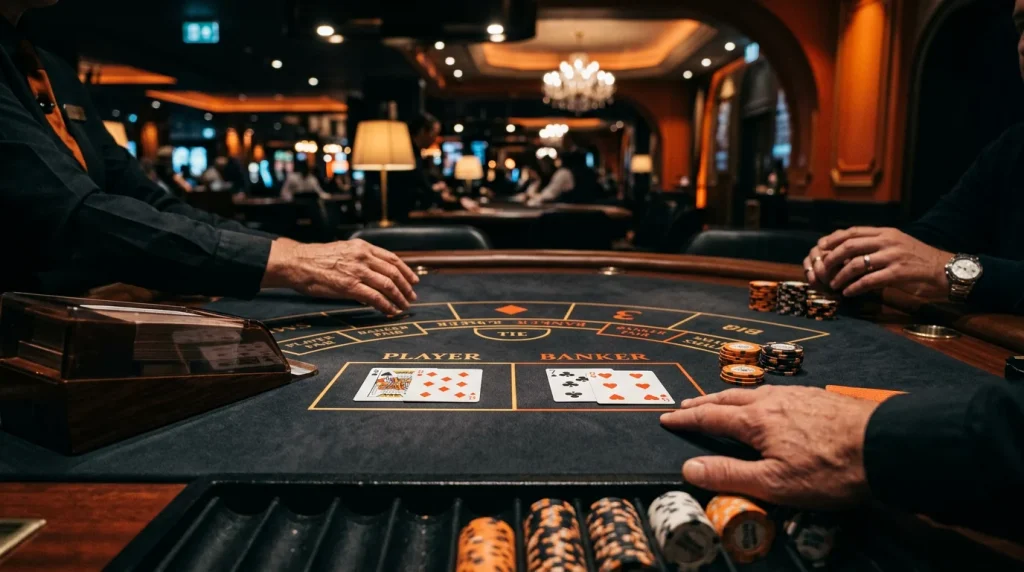
Every round of baccarat revolves around a simple objective: predicting which of two hands—the Player or the Banker—will score closest to a total of nine. Face cards and tens count as zero, aces count as one, and all other cards hold their face value. If a hand total exceeds nine, you drop the tens digit entirely, meaning a fifteen simply counts as a five.
Betting Options: Player, Banker, and Equality Wagers
You can place your chips on three primary outcomes during any given round at a digital dealer table. The Player bet pays even money, while the Banker bet also pays even money minus a standard five percent commission taken by the house. A Tie bet offers a tempting payout, usually eight to one or nine to one, but carries a massive house edge that makes it a dangerous trap for disciplined crypto grinders.
Decoding the Commission Structure on Banker Wins
That five percent commission on Banker wagers exists because the Banker hand wins slightly more often over the long run due to drawing rules. Some tables feature a no-commission variant where a Banker win totaling six pays out at half value instead, changing the underlying math. If you ignore how these percentages nibble at your stack, your balance will vanish faster than an unconfirmed mempool transaction during network congestion.
Applying Mathematical Edge Concepts to Your Session
The house edge on a Banker bet sits comfortably around one point zero six percent, making it mathematically the safest choice on the felt. Player bets carry a slightly higher edge at roughly one point twenty-four percent. When you evaluate these figures alongside the platform mechanics discussed in my Are Live Dealer Tables Worth It in NZ? analysis, you realize that straying from these two primary wagers is pure financial suicide.
Evaluating Side Wagers and Their Hidden Costs
Side bets like Perfect Pairs or Dragon Bonus promise massive payouts that look good on paper. Unfortunately, these optional wagers often push the house edge past ten percent, bleeding your crypto balance dry long before you hit a lucky streak. I always advise treating side bets as expensive entertainment rather than a reliable strategy for growing your bankroll.
Bankroll Management and Network Fee Realities
Managing your crypto capital means accounting for blockchain gas fees every time you move funds on or off the platform. Fiat users enjoy traditional credit cards, but they suffer through sluggish settlement times and annoying currency conversion markups. To see how these real-time streams compare with other classic table games, take a look at my insights on Master Skycity European Roulette for a broader perspective on digital table performance.
Legal Realities for New Zealand Players
Playing on offshore platforms while residing in New Zealand means navigating the nuances of the Gambling Act 2003, regulated by the Department of Internal Affairs (DIA). While local laws prohibit operating interactive gambling businesses from within the country, individuals are not blocked from accessing international sites. Always verify that your chosen platform maintains strict security standards and transparent payout protocols before depositing funds.
Common Table Signals and Safety Indicators
Table Metric | Good Signal | Caution Signal
Commission Rate | Standard 5% or transparent No-Commission rule | Unusually high hidden cuts on wins
Stream Latency | Under two seconds with stable frame rate | Frequent freezing or audio desync
Shoe Type | Eight-deck manual or automated continuous shuffler | Opaque shoe changes without audit logs
Bet Limits | Clear minimum and maximum caps displayed | Dynamic limits shifting without notice
Payout Speed | Instant crypto release to self-custody wallet | Mandatory multi-day holding periods
Common mistakes
- Chasing previous losses by recklessly doubling down on risky tie wagers.
- Forgetting to factor in blockchain withdrawal fees when calculating session profits.
- Ignoring the small print regarding commission structures on no-commission tables.
Common questions
What is the absolute best bet in baccarat?
The Banker bet offers the lowest house edge, making it statistically the most reliable choice over time.
Are side wagers worth playing?
No, because their high house edges quickly deplete your crypto balance with very low hit frequencies.
Why is there a commission on Banker wins?
The commission compensates for the slightly higher winning probability of the Banker hand.
How does New Zealand law affect my play?
The Gambling Act 2003 administered by the DIA regulates local operators, but does not penalize players using offshore crypto-friendly sites.
Should I use fiat or crypto for these tables?
Crypto offers faster settlements and avoids annoying fiat conversion spreads, provided you watch out for network fees.
Where this leaves you
Baccarat is a streamlined game of pure chance where disciplined bankroll management outweighs complex systems every single time. This approach suits analytical players who enjoy low-edge card games and value fast crypto settlements without administrative delays. It does not suit thrill-seekers looking for complex skill-based decisions or those who cannot tolerate the mathematical certainty of the house edge. The rigid house rules occasionally cause frustrating losing streaks even with optimal play.